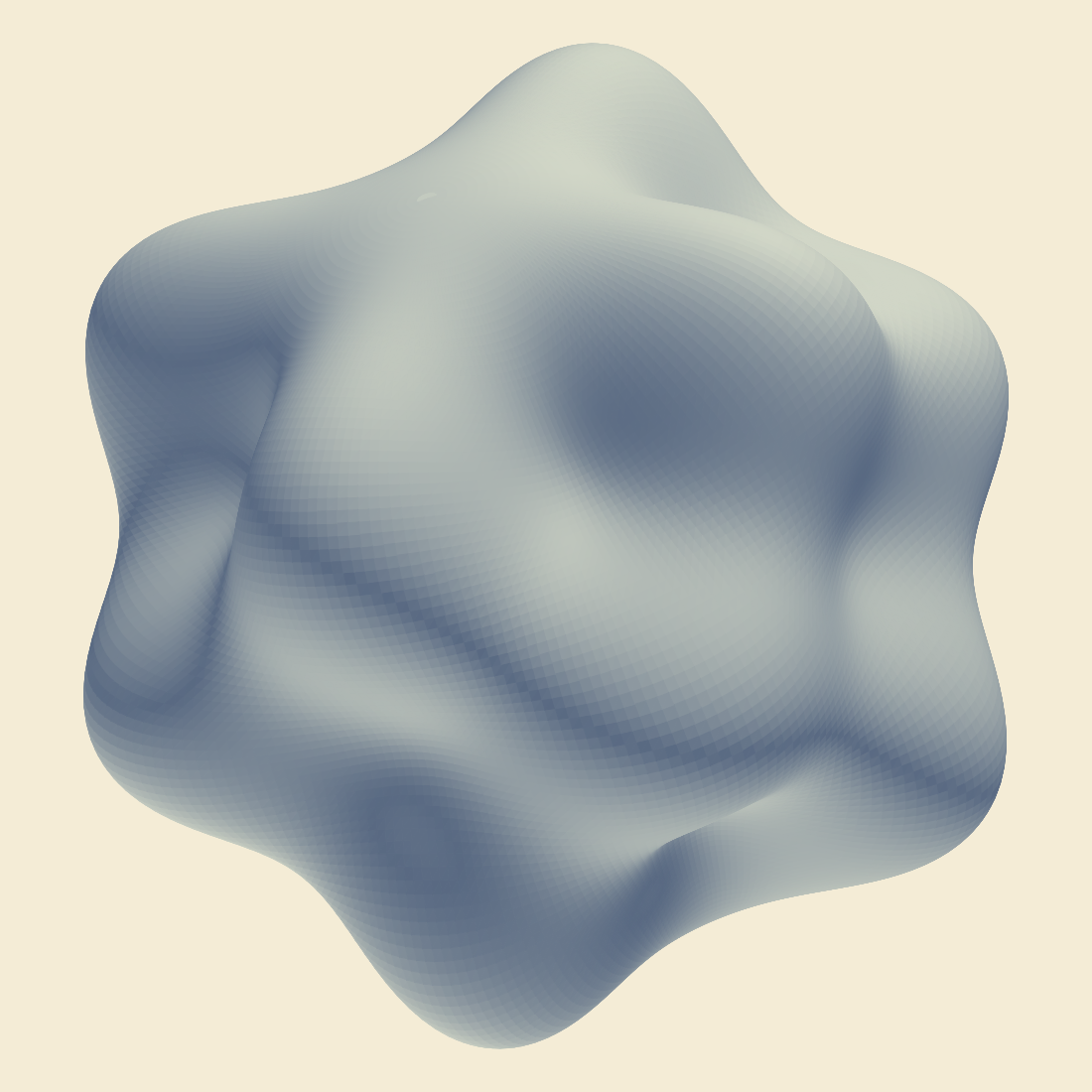
Shape Explore III. The first two entries carved a static form; this one is about a process. On a curved space the harmonic functions form a tiny, rigid space, and heat flow drives every field toward it. The shape to look at is not the endpoint but the relaxation, a lumpy sphere smoothing itself back to round, each bump fading at a rate the geometry fixes. Made visible first; the same numbers make it audible next.
The harmonic is the kernel of the Laplacian
A function is harmonic when the laplacian annihilates it, . That kernel is not arbitrary. Hodge theory identifies , so the harmonic space sees topology, and its dimensions are the Betti numbers. On the round sphere , which is simply connected, the harmonic functions are just the constants, ; every richer standing wave is a higher eigenfunction, a spherical harmonic with eigenvalue . These are the sphere’s modes, and the picture above is one of them, drawn as a radial deformation .
Convergence is heat flow
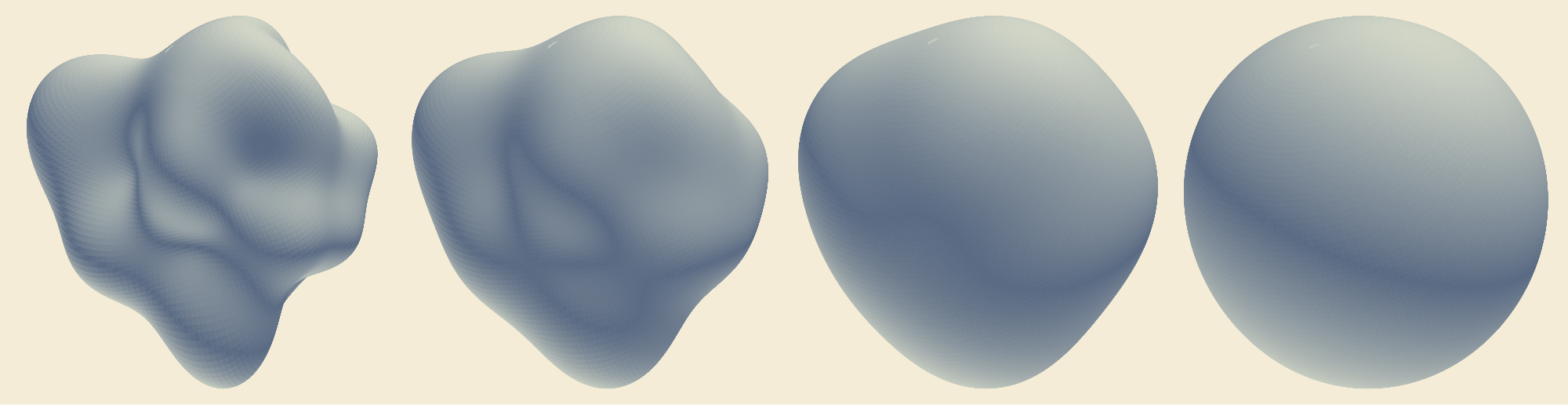
Give the sphere a lumpy field and let it diffuse. The heat equation solves as coefficient decay in the eigenbasis,
so each mode fades at its own rate . The fine, high- wrinkles vanish first, the broad low- swells last. In the limit only survives, and the field relaxes to its harmonic part, here the constant, a perfectly round ball. The approach is exponential at the spectral gap .
Left to right: . The same field at four times; the high modes vanish first, and the form converges to the harmonic. Every frame is , computed in closed form.
The lever is the spectrum
The eigenvalue is the decay rate of mode , the single lever, and the geometry sets it. Heat flow is therefore a smoother, a low-pass filter whose cutoff sweeps down through the spectrum as grows. What the eye reads as “the shape at time ” is exactly the band of modes with that have not yet died. Change the manifold and the spectrum changes with it, hence which wrinkles are long-lived. The dynamics is a readout of the geometry.
The sheaf-Laplacian bridge
The same operator lives on discrete objects. The laplacian of a graph is for the incidence coboundary, and of a cellular-sheaf it is for the restriction maps. Heat flow then does the discrete version of the same thing. It drives an inconsistent family toward the nearest global section, its harmonic cochain. That is precisely the picture behind fragment 2-RDM sheaves, where the coboundary’s residual measures how far overlapping predictions disagree. Running it to zero is heat flow to the harmonic, and the leftover floor is a genuine obstruction, the nearsightedness at the model’s radius. See fragment-2-rdm-sheaf. The smooth sphere and the learned quantum marginal are the same theorem at two resolutions.
Before sound
The spectral picture is already a score. Each mode is a pure tone at pitch set by , struck with amplitude and decaying with envelope , a plucked, ringing-down chord whose timbre is the shape’s spectrum. Kac’s question, can one hear the shape of a drum?, becomes a compositional one, namely to render the relaxation as the sound it already is. That is the next entry; this one is its picture.
A harmonic pendant
Application
The deformed sphere is a closed surface, so the lumpy field prints as a pendant or a diffuser whose bumps are standing waves, not ornament. Pick a time to set how smooth it reads, early for a knobbly bead, late for a near-sphere with a few soft swells.