In the spacetime construction a spatial Laplacian is glued to a temporal generator , and the whole interest lies in how they interact. The cleanest special case has an exact answer. The two commute precisely when no energy ever moves between the modes of the Laplacian, and when they do not commute, the commutator says which modes exchange energy and how strongly.
The statement
Let be a symmetric operator, such as a graph or sheaf Laplacian, with distinct eigenvalues and orthogonal spectral projections , so that and the eigenspaces are the modes of space. Let be any linear generator of the dynamics . The following are equivalent.
.
The flow maps every eigenspace into itself, for every .
No state transfers energy between modes, meaning that a state starting in has no component in any with at any later time.
Off the commuting case the commutator measures the transfer block by block,
so the energy that mode sends into mode at the first instant is governed by the off-diagonal block .
Why it holds
Each projection is a polynomial in , by Lagrange interpolation on the finitely many eigenvalues. If commutes with it therefore commutes with every , hence so does , and stays in . That gives the first implication, and the second is immediate. Conversely, if no transfer ever occurs then for all whenever , and differentiating at gives . The generator is then block diagonal, , which commutes with . The block identity follows by multiplying by on the left and on the right, since and .
Adding diffusion changes nothing here. The full generator has the same commutator with as does, so diffusion damps each mode at its own rate but never moves energy between modes.
A selection rule on the ring
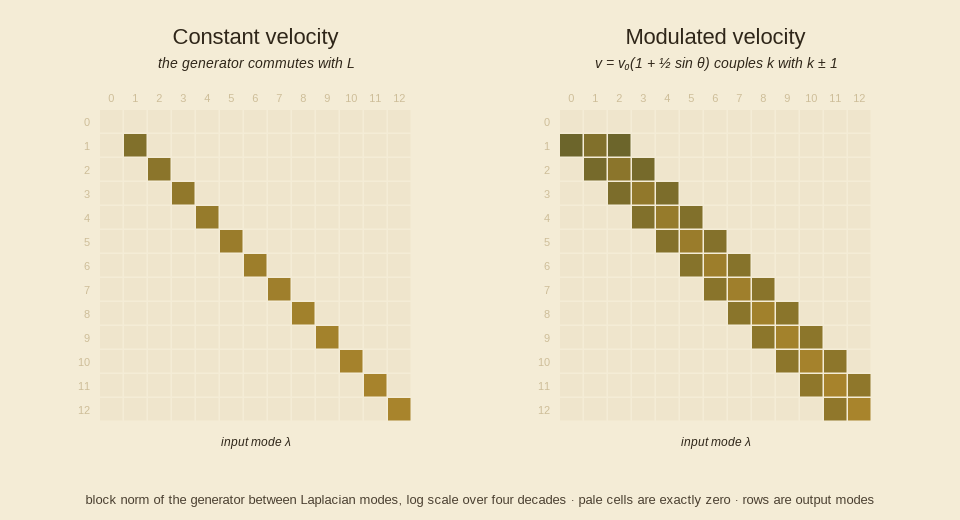
On a ring the modes of the Laplacian are the Fourier modes , and a transport generator in flux form multiplies the field by the velocity before differencing. Multiplication by a velocity with Fourier content shifts a mode to , while the difference operator is diagonal. Hence only when lies in the support of . A constant velocity has only , so it commutes with and every mode keeps its energy. A velocity modulated by a single harmonic, , has and couples each mode only to its immediate neighbours.
Block norms of the generator on a ring of nodes. With constant velocity the matrix is exactly diagonal. With a single-harmonic modulation the only off-diagonal blocks are the neighbours , as the selection rule predicts. The row and column of mode vanish because transport in flux form conserves mass. Computed in Lean (code/SpacetimeLab.lean).
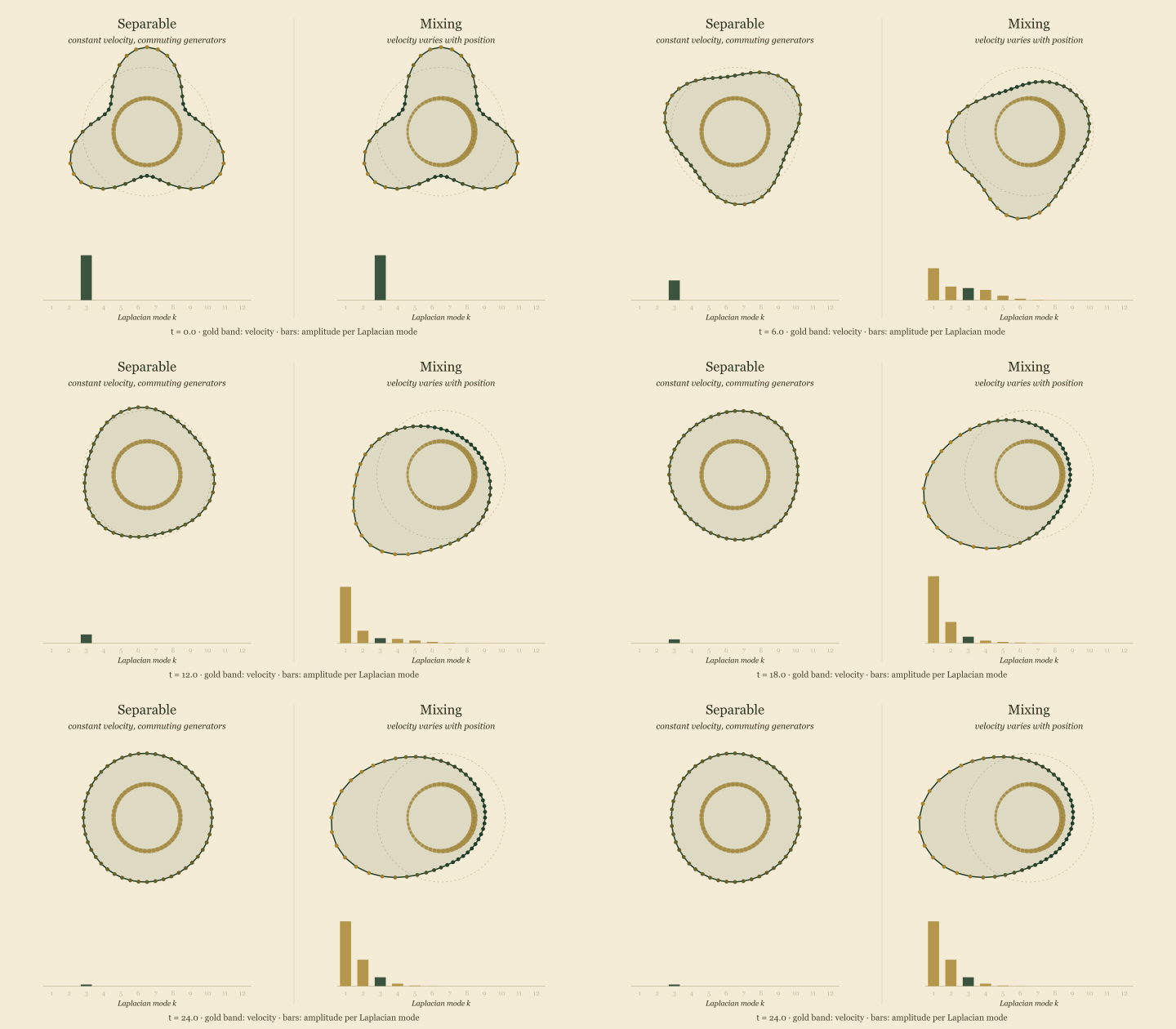
The dynamics shows the same thing. Starting from the single mode , constant velocity keeps all the energy in while it rotates and decays, whereas the modulated velocity passes energy down the chain to and then , one neighbour at a time.
Left, constant velocity. Right, the single-harmonic modulation. The bars are the amplitude in each Laplacian mode.
What it means for the spacetime picture
The separable generator of the spacetime construction is the commuting case, and the theorem says exactly what it costs. It can never move energy across the spatial spectrum, so every phenomenon that depends on such movement, mixing, filamentation, the transfer seen in the narrative version, lives in the off-diagonal blocks. Those blocks are the commutator, and on a ring their pattern is read directly off the Fourier content of the velocity. In the language of the Koopman operator, commuting means that the Koopman modes of the dynamics can be chosen among the harmonic modes of space, and mixing is the failure of that choice.
References
B. O. Koopman, Hamiltonian systems and transformation in Hilbert space, PNAS 17 (1931).
J. Hansen, R. Ghrist, Toward a spectral theory of cellular sheaves, J. Appl. Comput. Topol. 3 (2019).
R. A. Horn, C. R. Johnson, Matrix Analysis, 2nd ed., Cambridge (2013), on simultaneous diagonalisation of commuting matrices.