Shape Explore II. Calabi–Yau gave a smooth surface; here the mathematics is faceted from the start. A tropical polynomial is piecewise-linear, so its shape is flat panels meeting at sharp edges — the geometry of a cut mineral. One family of equations, and a single lever of regularity, carries the form from a quartz crystal to an obsidian shard.
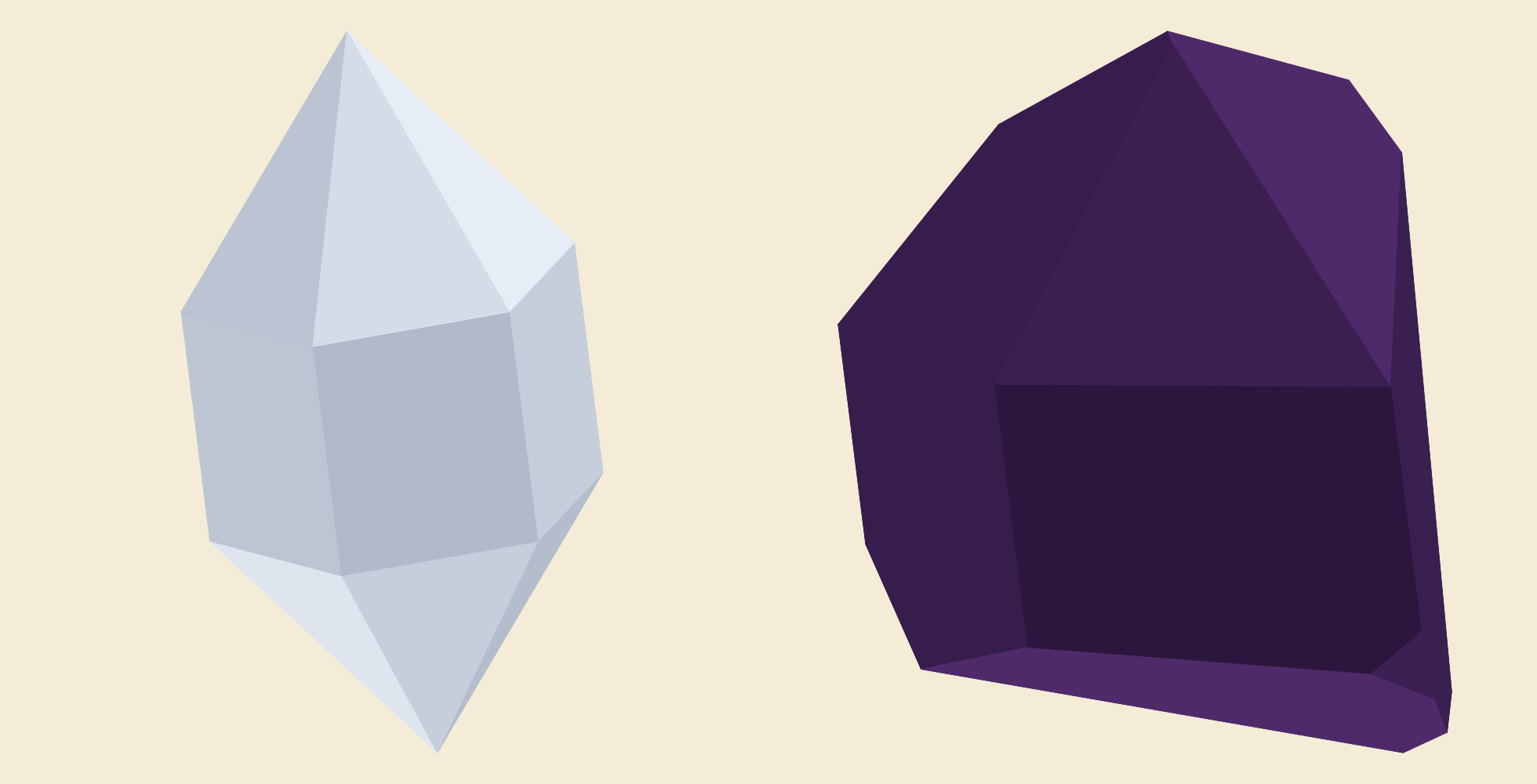
Left: six equal terms on a hexagon — a symmetric quartz. Right: generic terms, different top and bottom — an obsidian shard. Same construction; only the regularity of the data differs.
The object is a tropical variety
Work in the tropical (max-plus) semiring, where addition is
is then not a curve but a piecewise-linear function: over each region a single term wins and
That is exactly what a mineral is. Quartz grows as flat crystal faces meeting at fixed dihedral angles; obsidian, volcanic glass, fractures conchoidally into sharp planar shards. Both are collections of flat facets and sharp edges — the same category of shape a tropical polynomial produces for free.
Why this shape is honest, not decorative
The facets are forced by two theorems, not chosen by eye.
- Newton duality. The arrangement of facets is dual to a regular subdivision of the newton-polytope — the convex hull of the exponents
, lifted by the coefficients . Move a coefficient and you change the subdivision, hence which facets appear and how large they are. The lever is combinatorial and exact. - Balancing. Around every ridge the facet normals, weighted by lattice length, sum to zero. This is the tropical shadow of a conservation law, and it is why the panels close up into a solid instead of drifting apart.
And the whole object is a limit: tropicalisation is the log-limit (the amoeba’s spine) of an ordinary complex variety, so this crystal is the skeleton of a genuine algebraic surface — the bones of a shape, in the sense of the series.
The construction
Each term contributes one plane. Reading the graph
the intersection of the terms’ half-spaces — so the mesh is watertight by construction, and every face is a true tropical cell.
The levers that carve the form
| lever | what it moves | mineral meaning |
|---|---|---|
| number of terms | facet count | how many faces |
| exponents | facet orientation & symmetry | crystal system (hexagonal, …) |
| coefficients | which facets appear, their size | crystal habit and growth |
| convex cap up or down | orientation of the termination | |
| girdle | prism wall height | the crystal’s shaft between terminations |
| regularity of the data | symmetric vs generic facets | quartz ↔ obsidian |
The last row is the article’s point. Put the exponents on a regular hexagon with equal coefficients and the six facets are congruent: a symmetric hexagonal crystal, a quartz. Draw the exponents and liftings generically — uneven directions, unequal heights, a different set top and bottom — and the same construction gives an asymmetric, sharply-angled obsidian shard. One equation family; regularity alone slides between them.
The regularity lever, read off the figure
The opening figure is the whole argument in one frame. On the left, the six terms sit on a regular hexagon with equal coefficients: congruent facets, a clean prism girdle, matched terminations — a quartz, crystal-white. On the right, the terms are generic and the top and bottom draw from different sets: uneven facets, an off-axis habit — a knapped obsidian shard, black-purple. Obsidian is really an amorphous glass, but it fractures along flat conchoidal faces, so a faceted solid is the honest caricature. Nothing changed between the two but the regularity of the tropical data.
A crystal pendant
Application
Both forms are already the convex polytope described above, so the meshes are watertight — printable as-is, no shell repair. The quartz makes a clean pendant or a faceted lamp diffuser; the obsidian, a blunter charm. Turn the regularity lever a little and you get a smoky quartz between the two: a symmetric habit with one or two faces overgrown.
Download the quartz STL or the obsidian STL. Both are closed solids straight from the intersection of tropical half-spaces.