Shape Explore I. Go looking for a form but refuse to invent it. Take a variety cut out by a meaningful equation and find the projection that reveals a shape worth keeping. The Calabi–Yau quintic is the first specimen, and it shows exactly which levers do the carving.
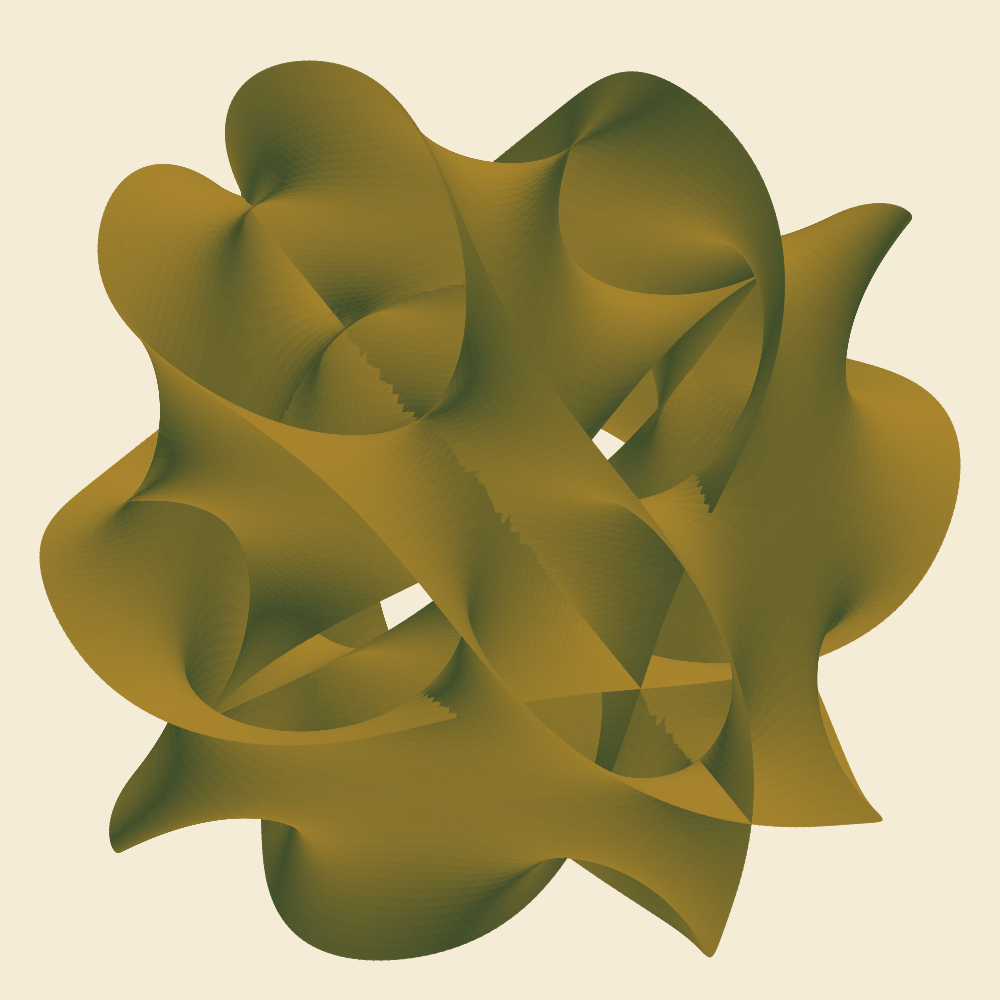
The specimen is a variety, not a blob
The primary object is an algebraic variety, the zero locus of polynomials. The Calabi–Yau here is the quintic, the smooth hypersurface cut out by a degree-five homogeneous polynomial in complex projective space
Why this variety is worth carving
Superstrings live in ten dimensions and must hide six. Keeping
The picture is a slice
The six-manifold cannot be drawn. The familiar image is a two-real-dimensional cross-section of the Fermat surface
The levers that carve the form
Each parameter moves the form the way the theory predicts, which makes the carving deliberate.
- Degree
fixes the genus , the symmetry , the patches, and the lobes per axis. Higher degree means more lobes and handles. Only and are themselves Calabi–Yau sections, the elliptic curve and the quintic threefold, whereas higher gives a general-type surface kept here purely as a form. - Phase patches
arise because the -valued power indexes sheets. Keeping a subset carves an open, asymmetric piece such as a cup or a dome. - Strip width
flares the petals as grows, since turn them into horns that can wrap a central cavity. - Projection angle
chooses which mix of becomes height. One real dimension must be dropped, and decides whether the centre opens or collapses. This is the craft. The projection type matters as much as the angle. An orthographic projection yields an elliptic cylinder, a stereographic one the familiar pendant form, and a gnomonic one a ruled hyperboloid. - Moving from Fermat to a generic equation breaks the symmetry into something organic, at the cost of the closed-form parametrisation.
- The true metric is only sketched by the algebraic slice, which is a skeleton. The Ricci-flat metric has no closed form and is now computed by neural networks, so the honest shape of a Calabi–Yau is itself a machine-learning object. That is where this form-hunt rejoins the rest of the wiki.
One lever at a time
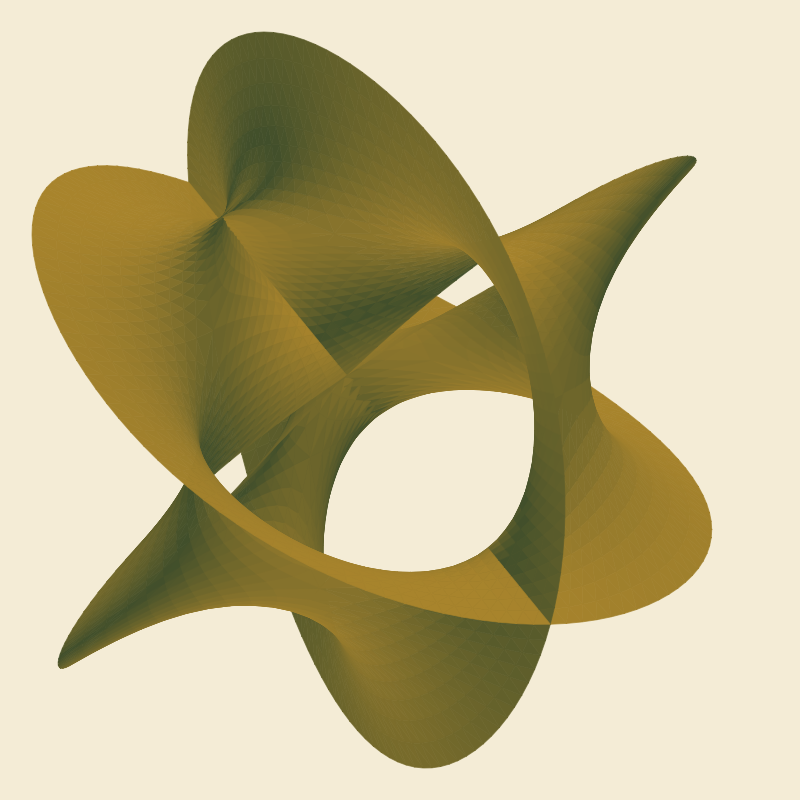
Degree
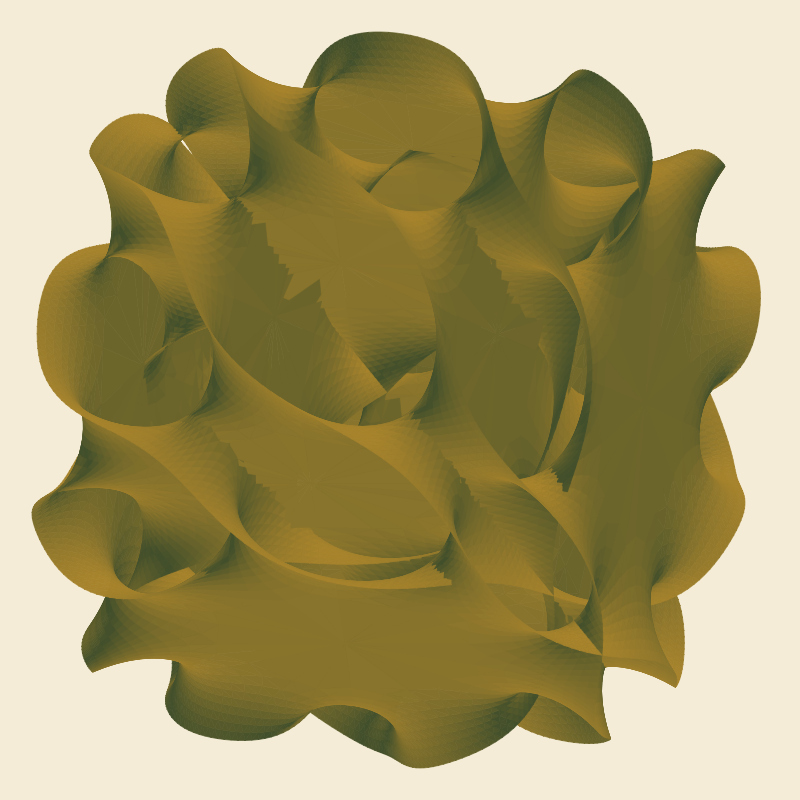
Degree
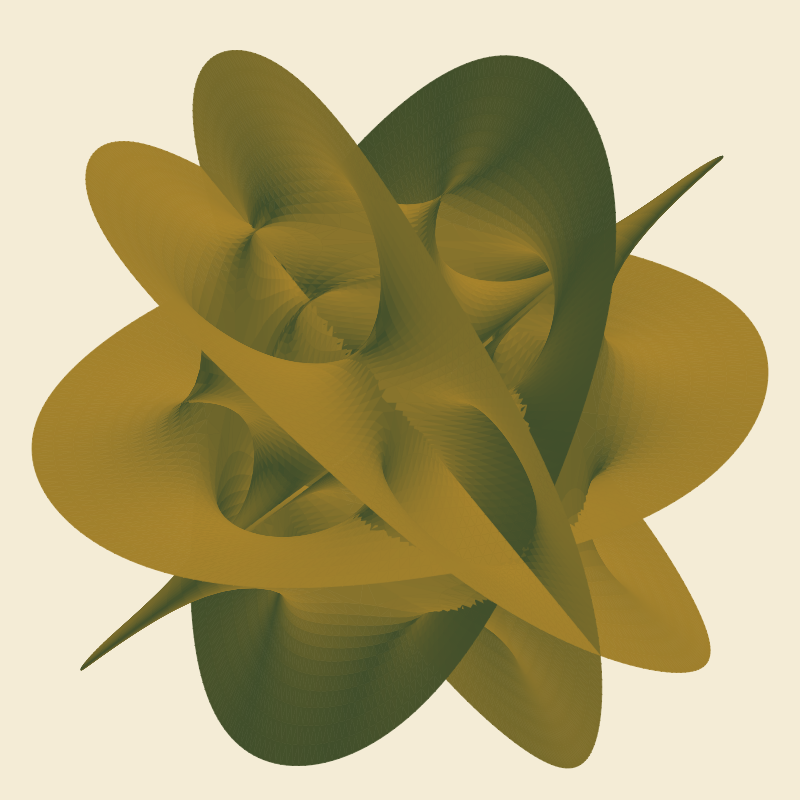
At large strip width
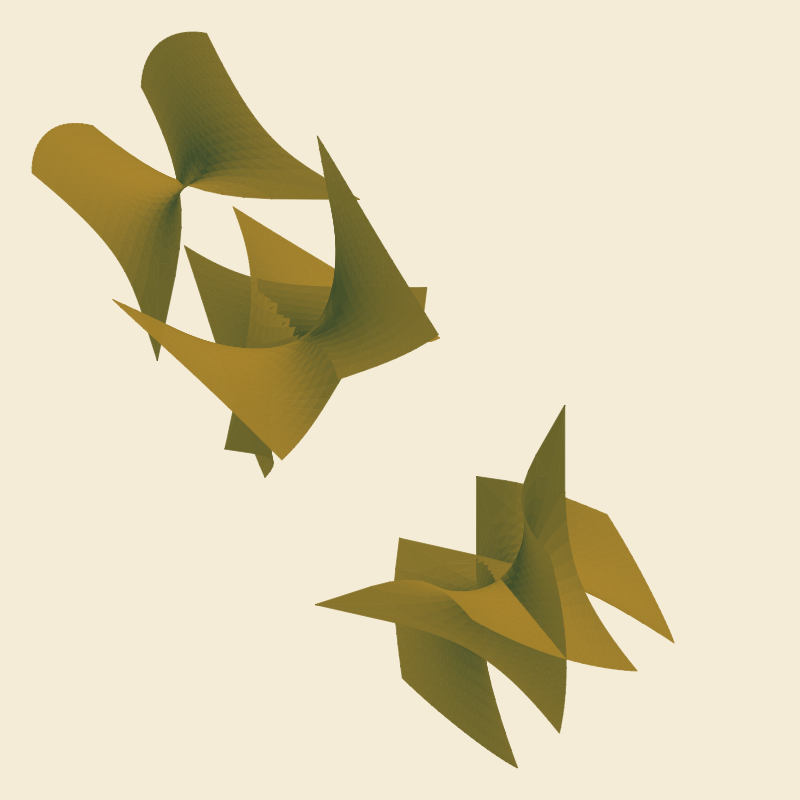
A diagonal patch subset carves the surface open into ribbons.
A pendant light
Application
The septic form above is the readiest lampshade, a shell whose lobes wrap the centre while the gaps between them serve as light apertures. To print it, give the surface a shell thickness and push
and the patch subset until the central cavity is clean. The result is a lampshade whose geometry is a theorem, not a motif.
Download the septic STL or the quintic STL. These are the raw cross-section surfaces; thicken them to a shell in your slicer for a watertight print.